
 sign up
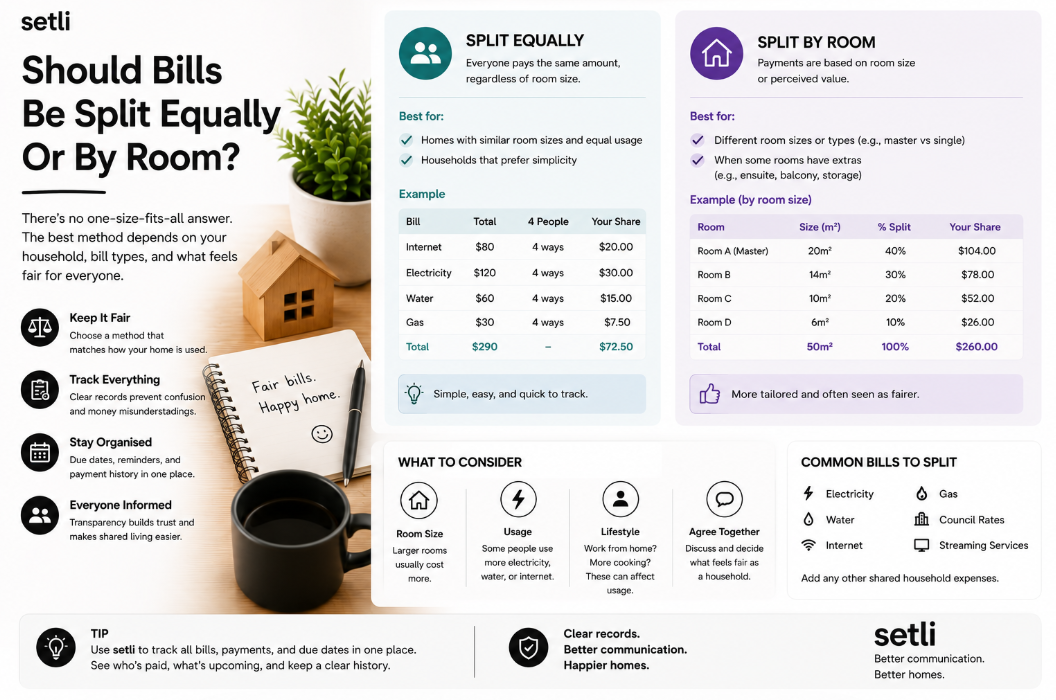
Should Bills Be Split Equally Or By Room? | Setli

Jun 27, 2026

6 min read
Splitting bills in a shared house is not always simple.
Some households split everything equally.
Others split bills by room, number of people, usage, or household agreement.
There is no single method that works for every shared house.
The fairest option usually depends on the household setup, who lives there, what bills are being split, and what everyone agreed to from the start.
The most important thing is to make the arrangement clear before problems happen.
Why Bill Splitting Methods Matter
Shared bills can become stressful when people have different views on what is fair.
One person may think every bill should be split equally.
Another may think a couple sharing one room should pay more.
Someone else may believe a person with a larger room or ensuite should contribute differently.
These discussions can become awkward if there is no clear system.
A fair bill split should be simple, agreed, and easy to track.
Equal Bill Splitting
Equal bill splitting is one of the most common methods.
This means each person pays the same share of the bill.
For example, if four housemates share a $200 electricity bill, each person pays $50.
This method is simple and easy to understand.
It can work well when:
everyone has similar usage
everyone has similar living arrangements
there are no couples sharing one room
all housemates agree it feels fair
the household wants a simple system
Equal splitting is often the easiest option for shared houses.
But it may not always feel fair in every situation.
When Equal Splitting May Not Work
Equal splitting can become difficult when household situations are different.
For example:
one person works from home
one person uses more utilities
a couple shares one room
one room has an ensuite
someone moves in halfway through the month
one person is away for a long period
some expenses only apply to certain people
In these cases, equal splitting may feel unfair to some housemates.
That does not mean equal splitting is wrong.
It just means the household should discuss whether another method is more suitable.
Splitting Bills By Room
Splitting bills by room means expenses are linked to rooms rather than individual people.
This can be useful when rent or household arrangements are already room-based.
For example, each room may have its own rent amount, and bills may be divided based on room allocation.
This can work well when:
rooms have different rent values
some rooms are larger than others
a room has an ensuite or private space
a couple shares one room
household costs are managed by room
the host wants room-based payment tracking
Room-based splitting can be helpful for rental properties where each room is treated separately.
Splitting Bills By Number Of People
Another method is splitting bills by the number of people living in the household.
This can make sense for utilities and shared household costs.
For example, if five people live in the home, each person pays one-fifth of the bill.
This may be fairer than room-based splitting when usage depends on people rather than rooms.
It can be useful for bills like:
water
electricity
gas
internet
household supplies
shared subscriptions
However, the household still needs to agree on the method clearly.
Usage-Based Bill Splitting
Some households try to split bills based on usage.
This may apply when one person uses significantly more of a service or utility.
For example:
one person works from home
one housemate runs extra appliances
one person has a private bathroom
one person uses more heating or cooling
one room has separate facilities
Usage-based splitting can feel fair, but it can also be hard to track.
Unless the usage is clear and measurable, this method may create more arguments than it solves.
Custom Bill Splitting
Some households need custom splits.
This may include situations where:
a couple shares one room
one person pays a larger rent share
some bills only apply to certain tenants
one person has agreed to cover a specific expense
a host lives in the property
a tenant moves in or out mid-period
Custom splitting gives households flexibility.
But it also needs clear records.
If custom amounts are not tracked properly, people may forget what was agreed.
Agree Before The Bill Arrives
The best time to discuss bill splitting is before the bill arrives.
Once money is already owed, the conversation can become more emotional.
Housemates should agree on:
which bills are shared
how each bill is split
when payments are due
who pays the bill upfront
how late payments are handled
where payment records are kept
Clear agreements help reduce disputes.
They also make it easier to manage bills consistently over time.
Keep The Method Consistent
Changing the bill splitting method too often can cause confusion.
For example, if electricity is split equally one month, by room the next month, and by usage the month after, people may lose track.
Consistency helps everyone understand what to expect.
If the household needs to change the method, it should be discussed and recorded clearly.
This avoids confusion later.
Consider Different Splits For Different Bills
Not every bill needs to be split the same way.
For example:
rent may be split by room
electricity may be split by person
internet may be split equally
water may be split equally
a room-specific expense may only apply to one tenant
a shared subscription may only apply to people using it
This can be fair, but it requires clear tracking.
The more flexible the split, the more important good records become.
Why Payment Tracking Matters
No matter which method is used, tracking matters.
A household should be able to see:
what the bill was for
how it was split
who owes what
when it is due
who has paid
who is still outstanding
what was agreed
Without this information, bill splitting can become confusing very quickly.
Clear payment tracking helps avoid arguments.
How Setli Helps With Bill Splitting
Setli is designed to help with rent, bills, shared expenses, reminders, payment history, and household payment tracking.
For shared households, Setli can help make bill splitting clearer by keeping payment details in one place.
Hosts can create expenses, track who owes what, set due dates, and manage payment records.
Tenants can see what they owe, when payments are due, and what has already been paid.
This helps reduce confusion around shared bills and household expenses.
Why Flexibility Is Useful
Every household is different.
Some shared homes are simple.
Others involve multiple rooms, couples, tenants, owner-occupiers, changing housemates, or different expense types.
A good bill management system should be flexible enough to handle different arrangements.
The goal is not to force every household to split bills the same way.
The goal is to make the agreed method clear and easy to manage.
Final Thoughts
Bills can be split equally, by room, by person, by usage, or through a custom arrangement.
The best method depends on the household.
Equal splitting is simple.
Room-based splitting can work well for room rentals.
Person-based splitting may suit utilities.
Custom splitting may be needed for more complex households.
Whatever method is used, the most important thing is clarity.
Everyone should understand how bills are split, when they are due, and where payment records are kept.
Setli helps shared households manage rent, bills, reminders, shared expenses, and payment tracking in one place, making it easier to keep everyone on the same page.